College has a hundred moving parts. Let's keep them in one place.
The major you pick comes with a price tag. The school you pick comes with deadlines. Addie keeps all of it on one screen — what you want, what it'll really cost, what's due when, and who in the family is handling which part.
colleges we price
2,100+
cost data from
IPEDS
tools, one profile
10
There isn’t one college decision. There are five, and four of them happen before you ever see a bill.
Every tool shows up at the point you actually need it. That’s the whole idea. You shouldn’t be hunting through menus the week something is due.
See which majors are actually on the table.
Two majors at the same school can be further apart in pay than the same major at two very different schools. This is also usually where a list goes wrong: built on the names everyone knows, which gets you admitted to schools that won’t pay for you.
Do the things you can still do.
Aid looks at your taxes from two years before your kid enrolls (2024 taxes for the 2026-27 year). Whose name the savings account is in, when a bonus lands, whether you sell stock. All of it gets decided in a year when nobody is thinking about college yet.1
Work backwards from the dates.
Some aid runs out when the money runs out. The right round, the right priority date, a parent FSA ID that takes three days to come through. It’s a scheduling problem long before it’s a money problem.
Read the letters carefully.
Loans show up listed as aid. Pull them back out, see what you would actually owe, and if you appeal, appeal on something the aid office has a form for: a job loss, a one-time bump in income, costs nobody counted.
Say yes to a four-year number, not a one-year one.
The letter only shows you freshman year. Tuition goes up, one-time awards disappear, and a dependent student can borrow $31,000 in federal loans in total. Four years at the annual limits use $27,000 of that.2
Every number on this page names where it came from.
Click any source. We note the period each figure covers and the day we checked it.
These are published limits and averages, not a prediction for your family. Your own numbers come from your profile.
Ten tools, one profile behind all of them.
You fill in your details once and nothing asks you again. Everything reads from the same profile, so when one answer changes, the rest catches up on its own.
Real screens from Admit Junction, with an illustrative family.
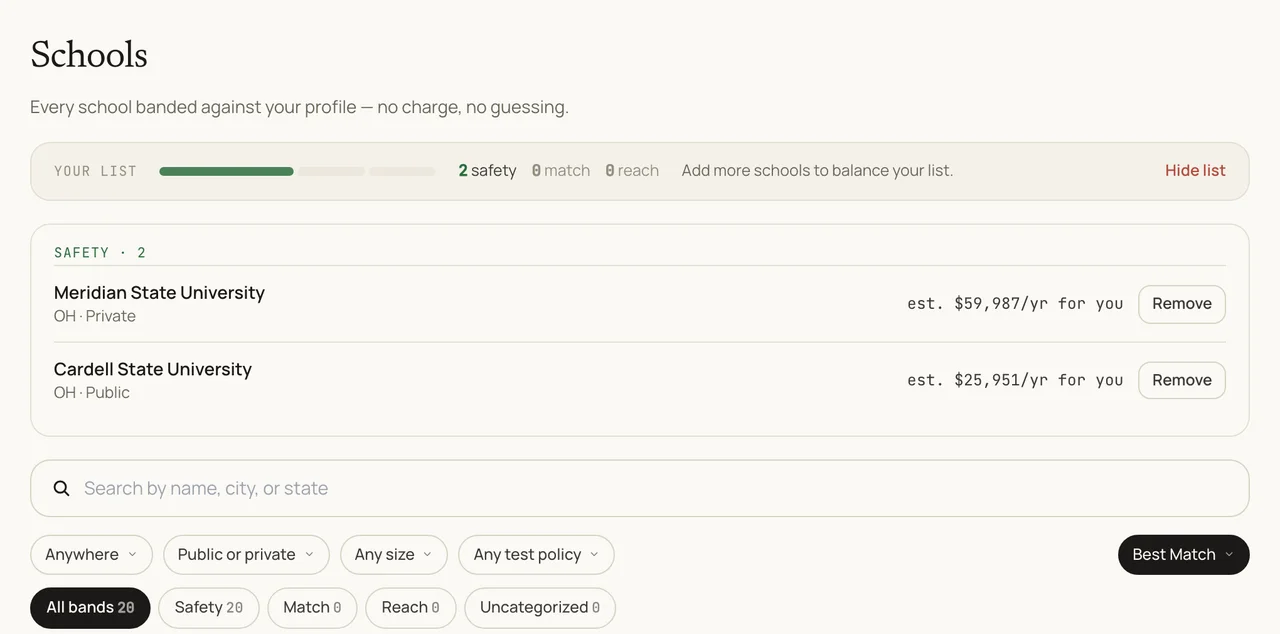
Every school is banded safety, match or reach against your profile, and your list keeps a running balance. Each school you add shows an estimated yearly price for your family.
You walk away with:A balanced list, with a price estimate beside every school on it.
Try the Finding and saving schools tour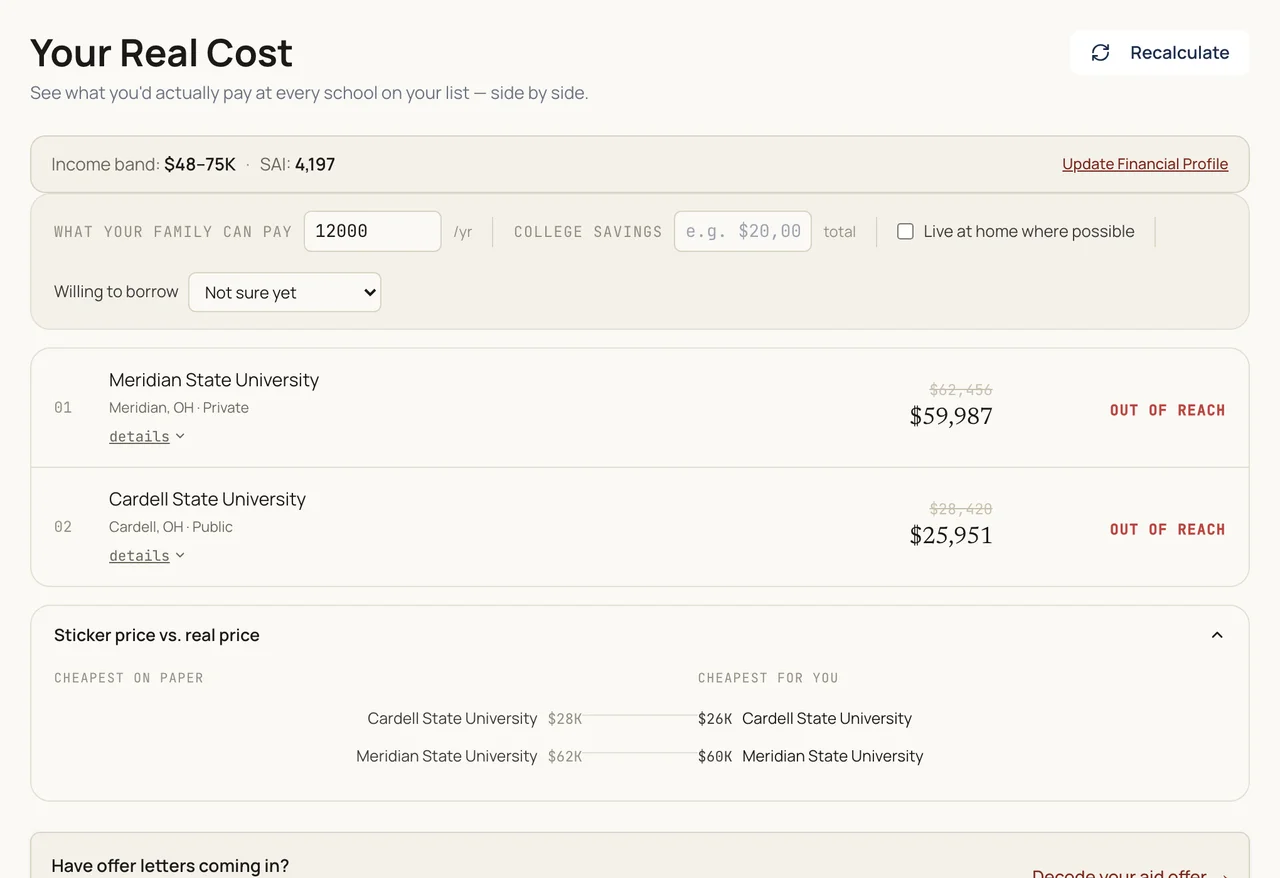
Every school on your list is priced after estimated aid, with the sticker price struck through beside what you would actually pay. Tell it what your family can pay each year and every price updates.
You walk away with:What each school costs you a year, side by side, and which ones are out of reach on what your family can pay.
See the What you’ll really pay tour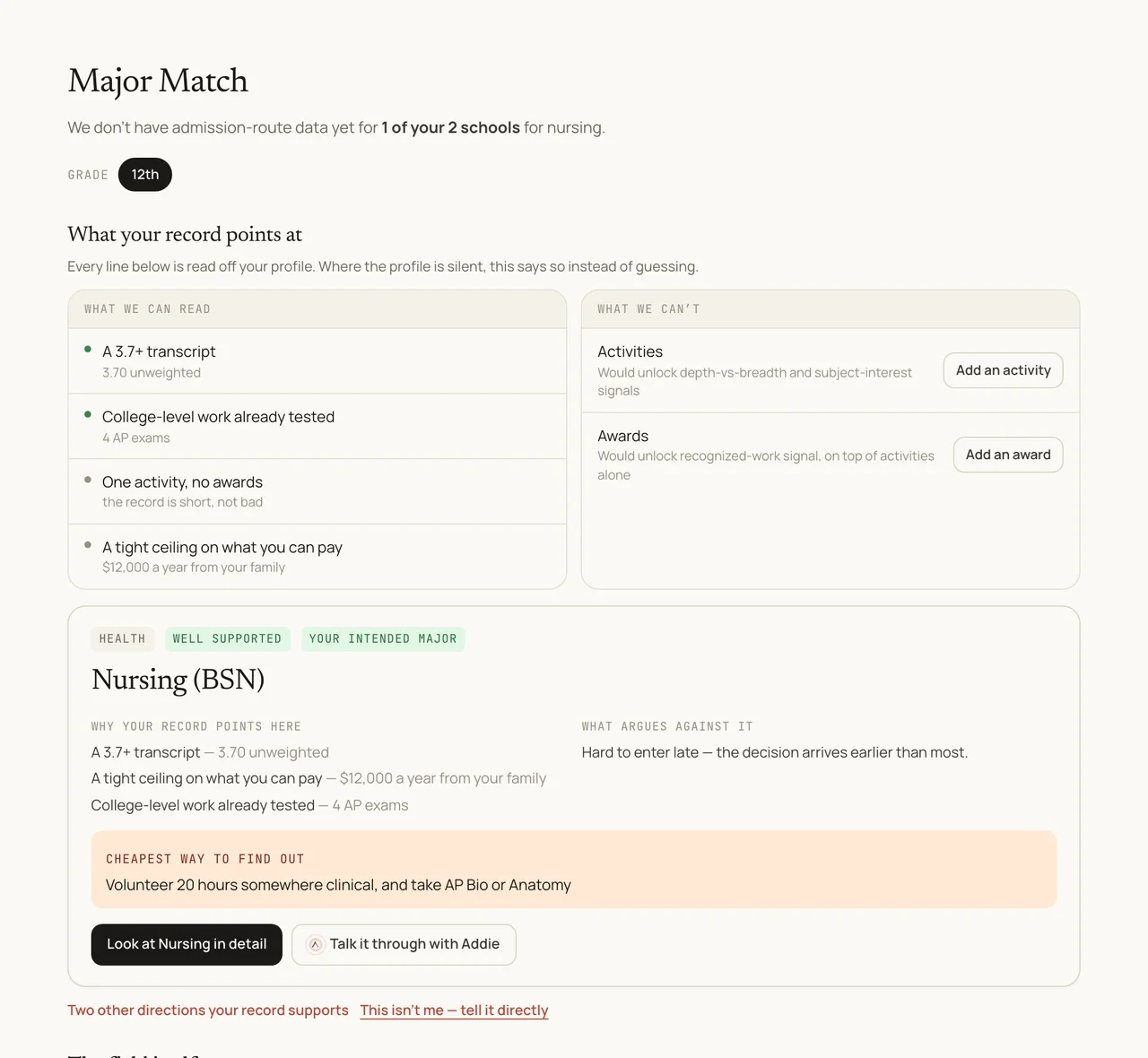
It reads your transcript, test scores and budget and says what your record points at, and what it cannot read yet. The lead card gives the reasons for a major, what argues against it, and the cheapest way to find out.
You walk away with:A first direction to test, with the reasons for and against it and one inexpensive way to try it.
Read: The school or the major, which one is worth more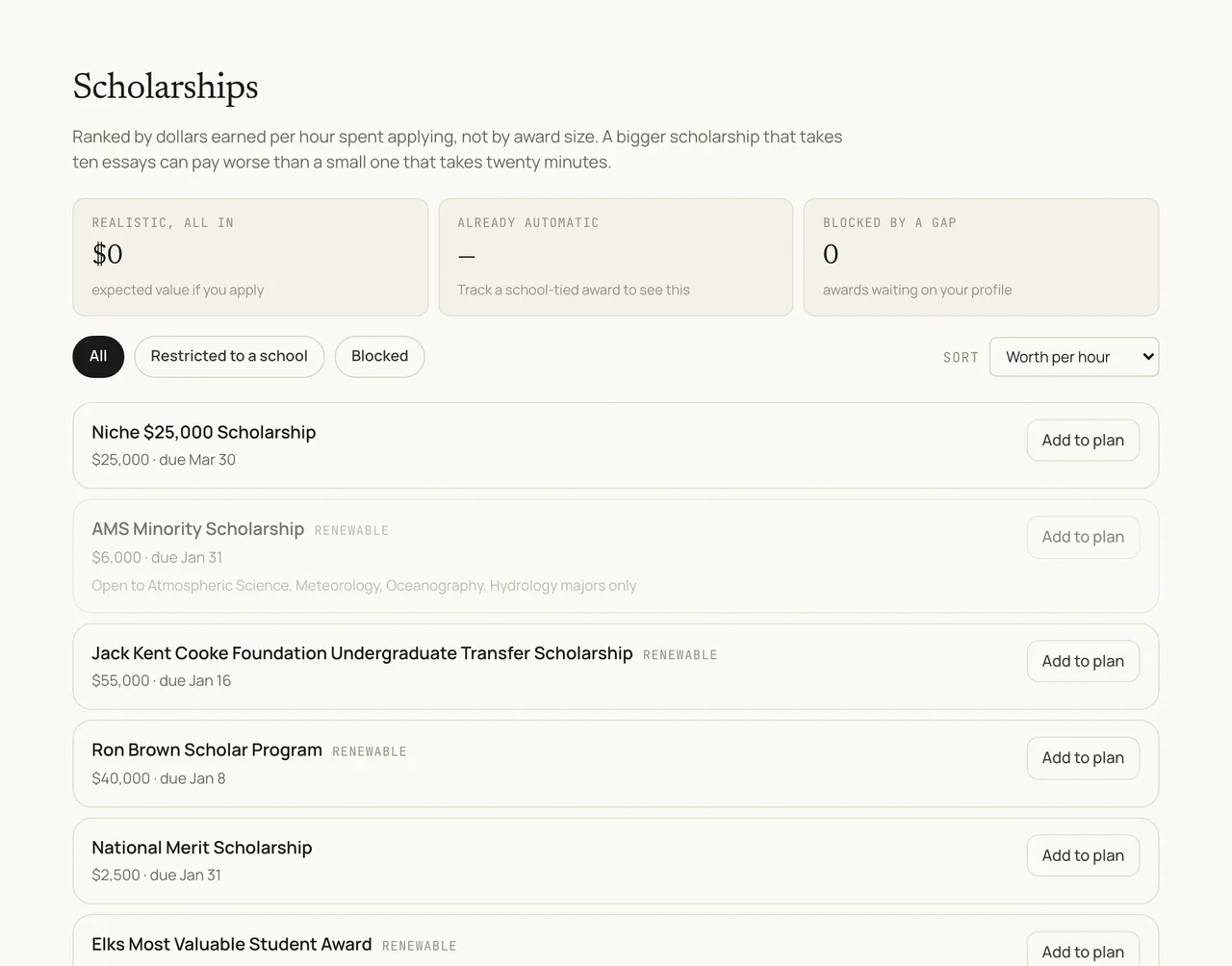
Awards are ranked by dollars earned per hour spent applying, not by award size. Ones tied to a school or blocked by a gap in your profile are marked, so you do not spend time on them.
You walk away with:A short list of awards worth the hours, with the long shots set aside.
Read: Your outside scholarship might not be yours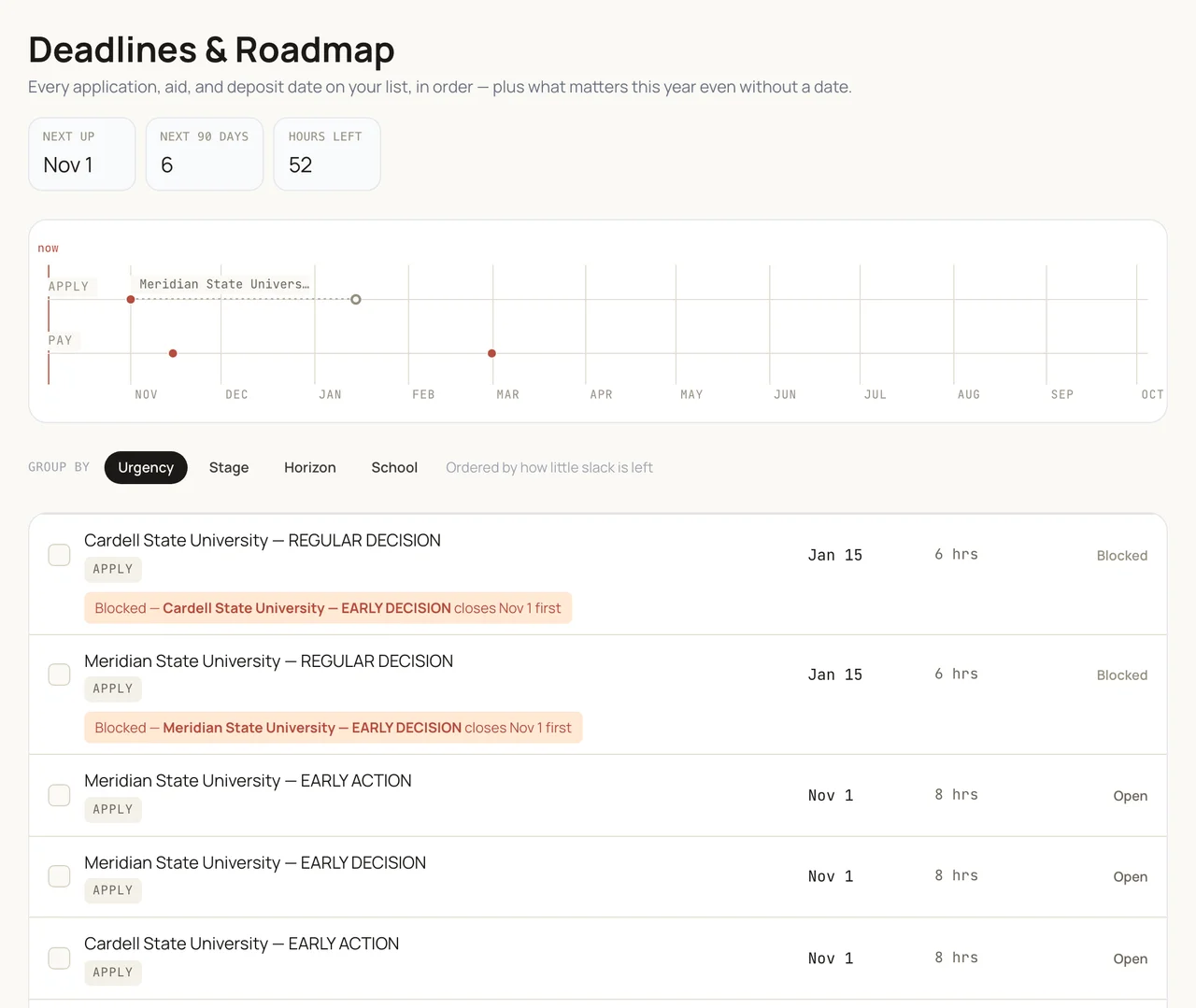
Every application, aid and deposit date for your schools, in order, on a season track and a list. When one deadline has to be met first, the next one says it is blocked.
You walk away with:Your next date, how many land in the next 90 days, and what is blocked until something else is done.
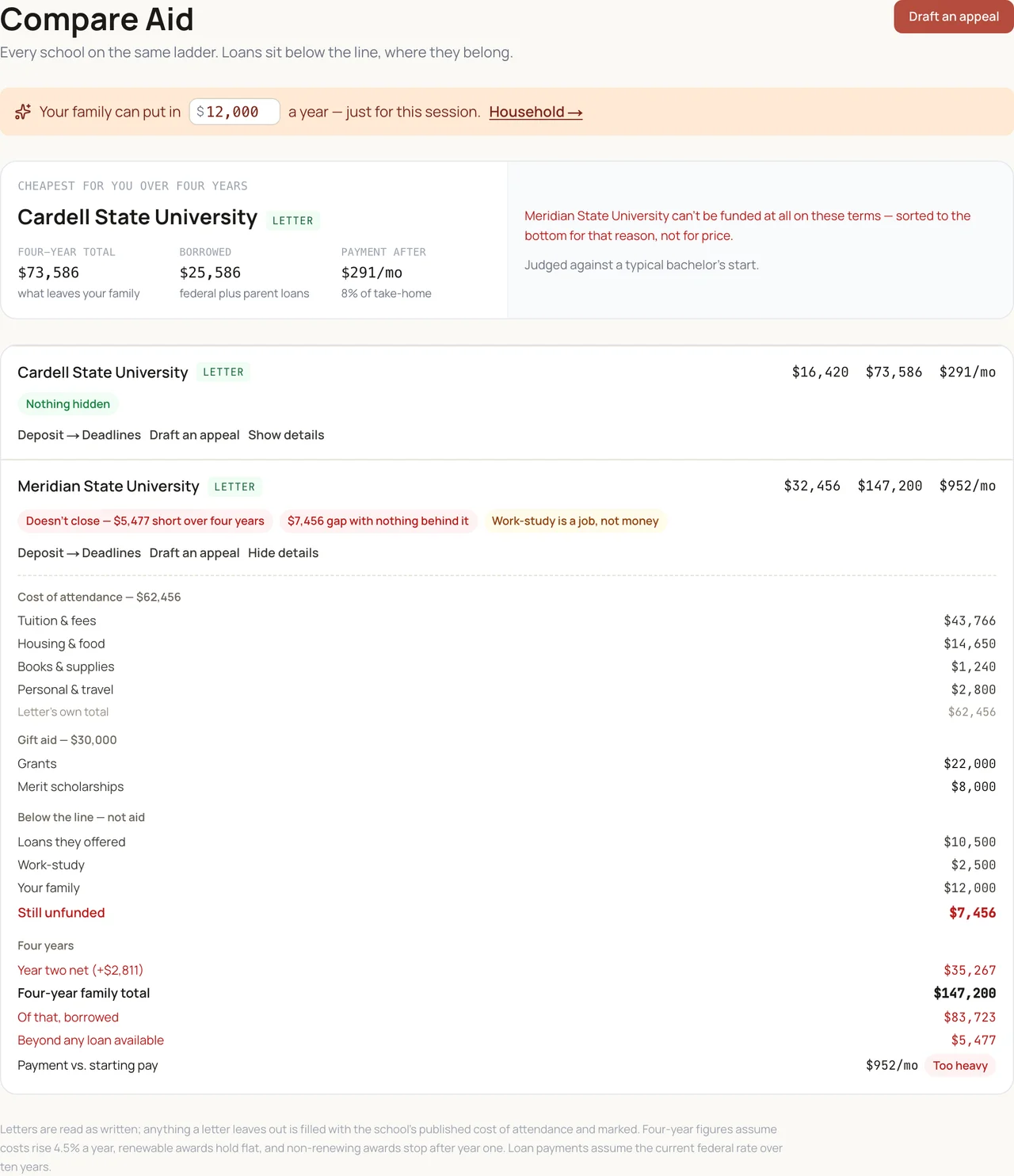
Upload each aid letter and every school goes on the same ladder, with loans and work-study set below the line where they belong. Each one shows what your family would really pay over four years, and the monthly payment after.
You walk away with:The cheapest school for you over four years, and which letter leaves a gap.
Watch: Reading a letter that’s hiding a loan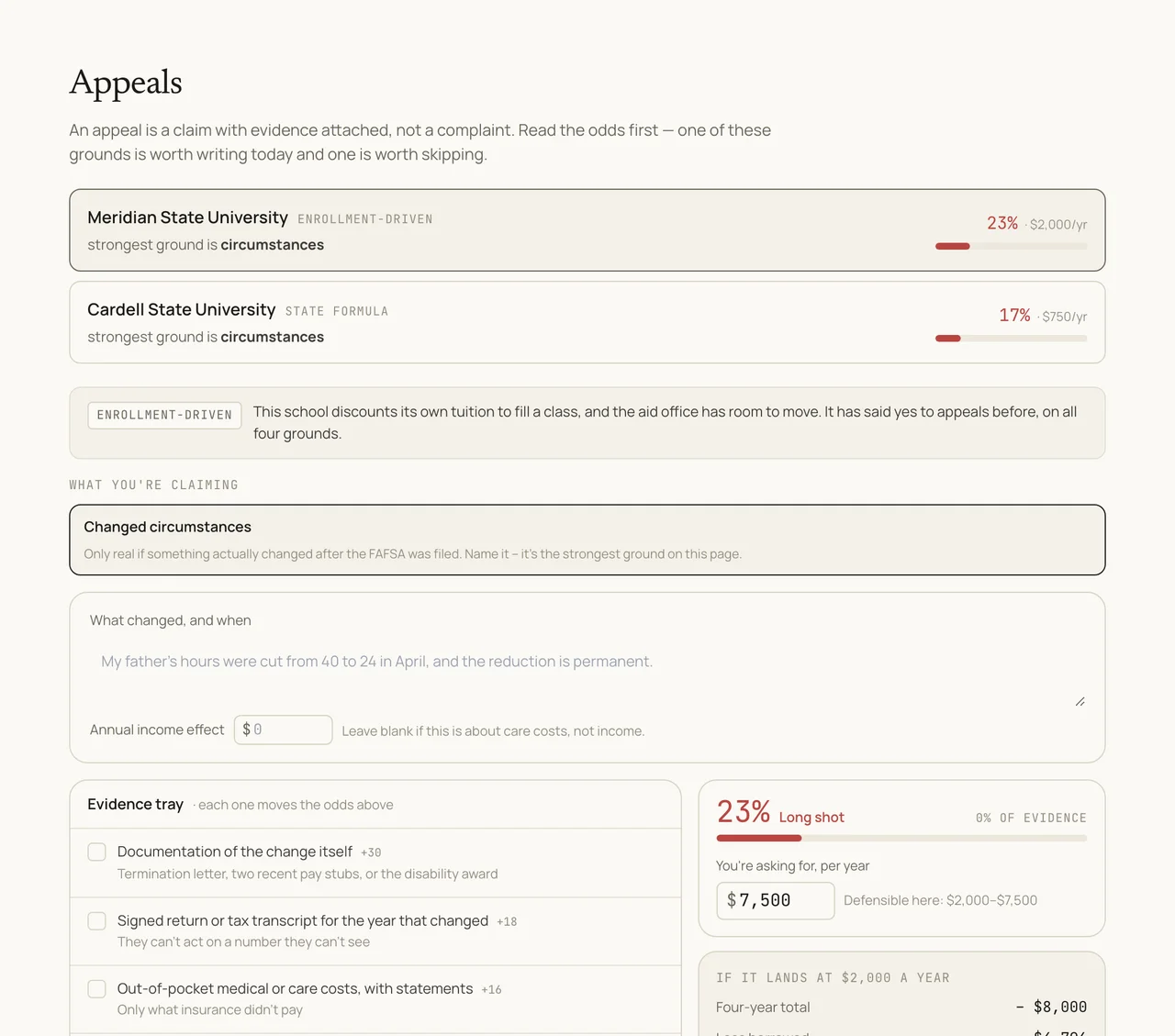
Pick the school and the ground you are claiming, and see the odds before you write a word. An evidence tray shows how much each document moves them, and what the appeal is worth if it lands.
You walk away with:A realistic read on whether an appeal is worth writing, and which documents to gather first.
Read: The four appeals that work, and the one that never does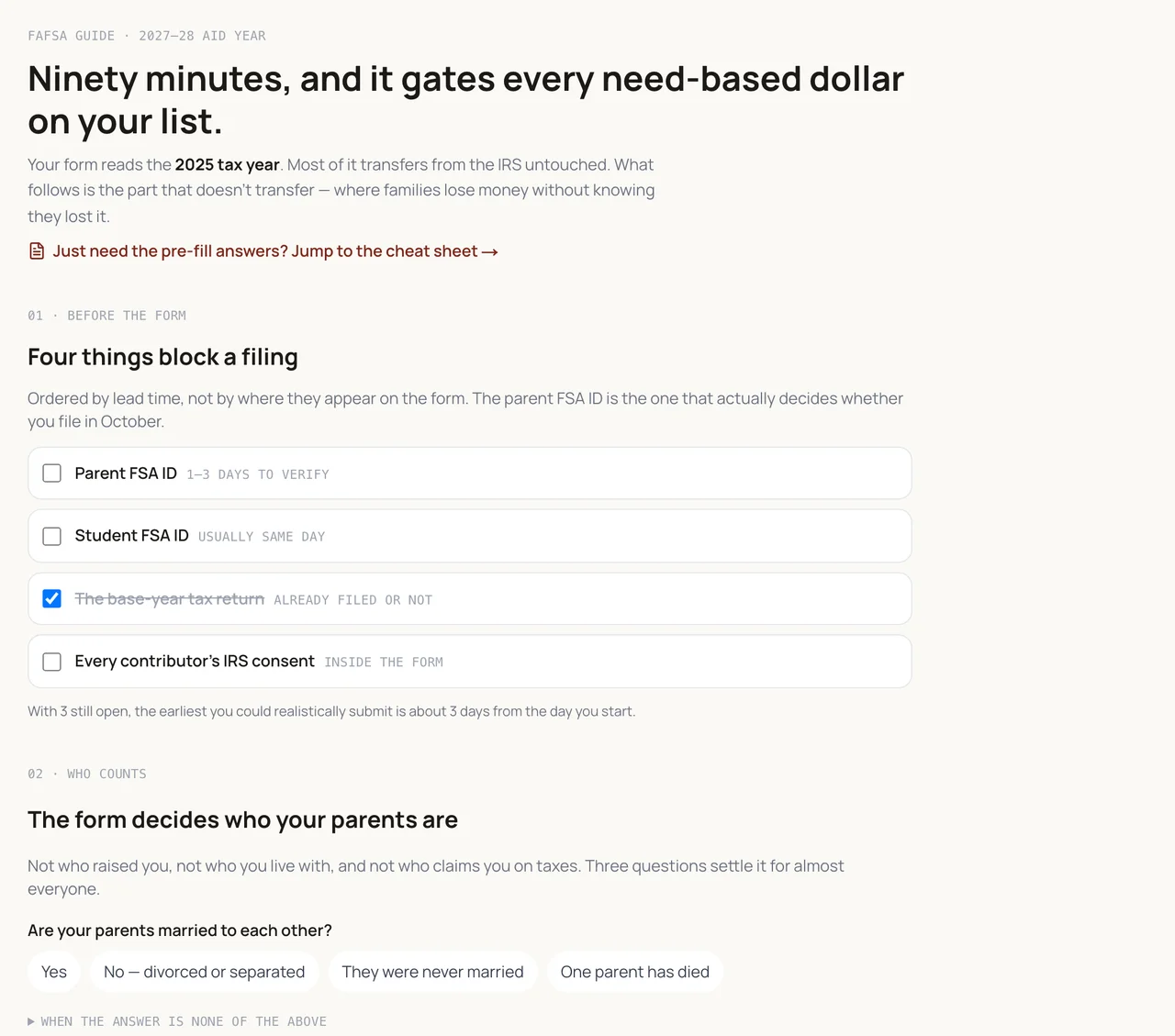
A guide to the 2027-28 form that starts with the four things that block a filing, ordered by lead time. It then settles who counts as your parent and points to the answers that move your aid.
You walk away with:A checklist of what to have ready before you start, and a cheat sheet of the pre-fill answers.
Watch: FAFSA night, a parent’s forty minutes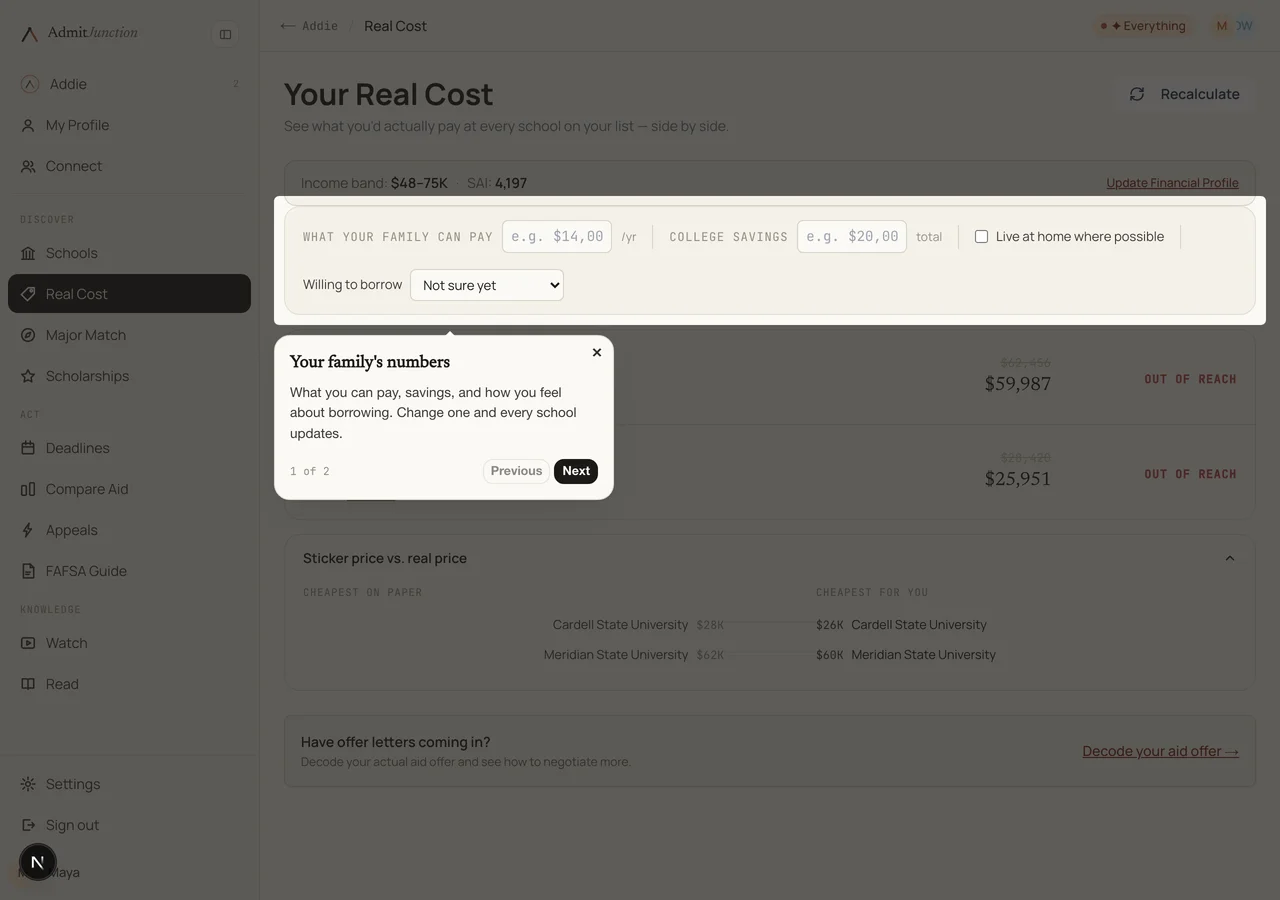
Guided tours open the real app and walk you through it a step at a time. Short walkthroughs cover the traps that cost families money.
You walk away with:Know where everything is, and what changes when you change a number, before you sign up.
See every tour and walkthrough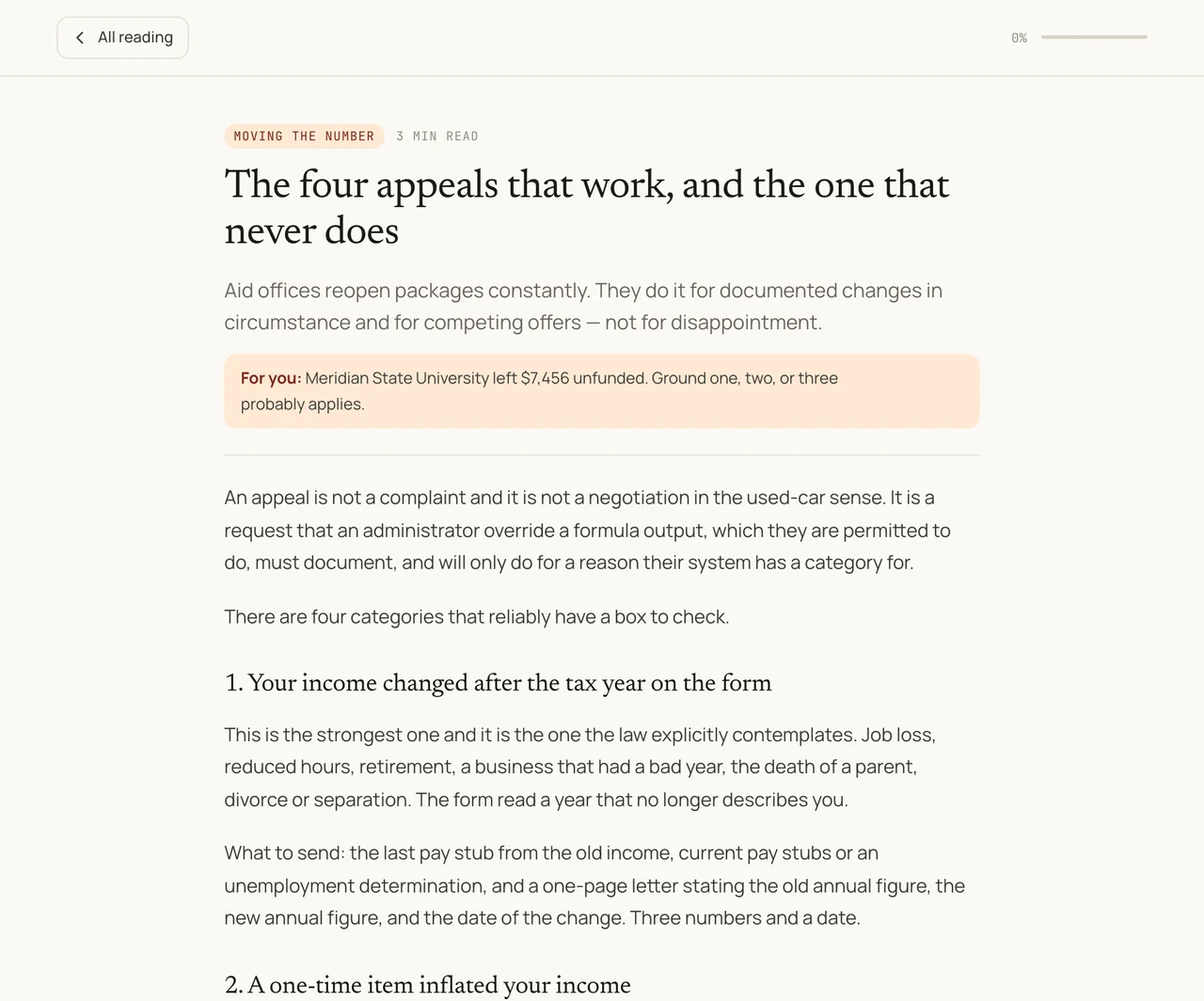
Longer reads on how college money works and what you can still change. When your profile has the numbers, the article names your school and your gap.
You walk away with:A plain-English answer, with your own figures where your profile has them.
Browse the reading listBring in a parent. No account needed.
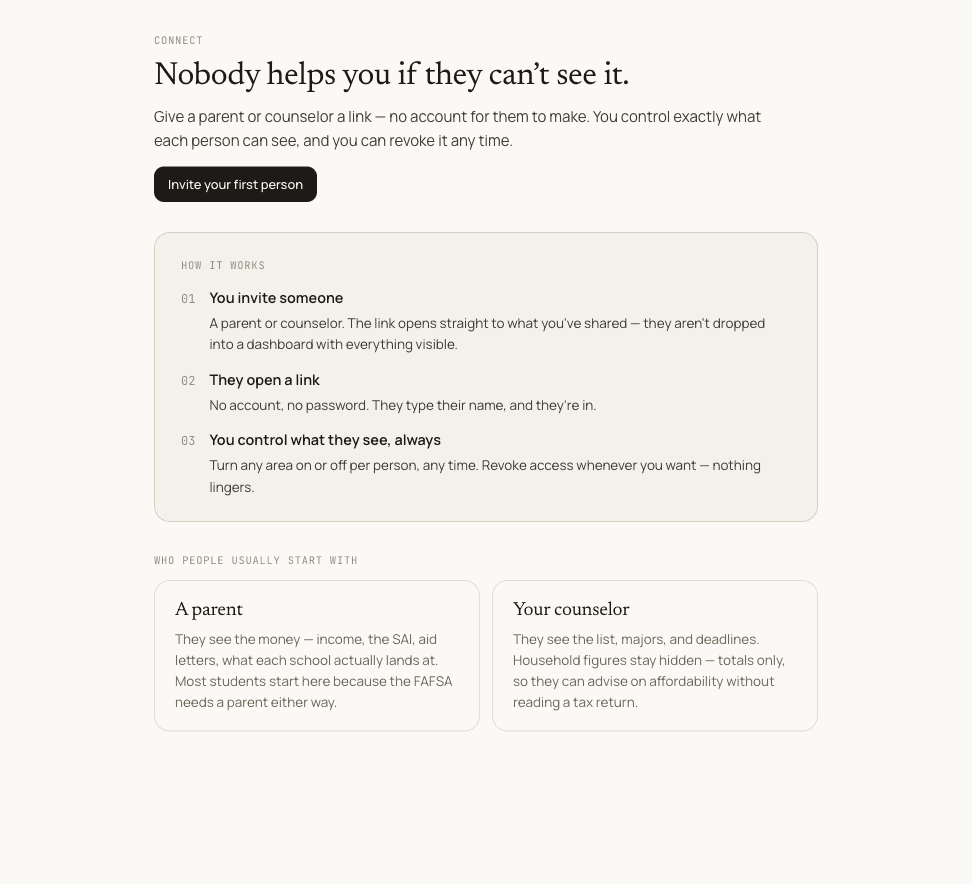
Send a link. They put in their name and a four-digit code and land right on the thing you asked about, not a dashboard they have to figure out. Anything they change comes back to you to approve first.
Most families can’t afford a private counselor. Here’s what one gets you, and what we do instead.
Independent counselors often charge thousands of dollars, and plenty of families never had that option at all. A good one is worth the money. But a lot of the job is spreadsheet work, and that shouldn’t be the reason a family goes without any help at all.
If you have a good counselor and you can afford one, keep them. Here’s what we’re not going to pretend about.
Read all of it before you pay us a dime.
Knowing what to do is the easy part. Everything in Watch and Read is free, and there’s nothing to sign up for.
One price. Everything in it.
No per-school fees, no extra charge for the appeal letter, no paying twice so a second parent can log in.
Cancel anytime. Our estimates come from federal IPEDS / College Scorecard data and each school’s published aid policy. They’re estimates, not offers, and we say so on every screen that shows one.